The Leadership Shock Factor: Different Strengths, Shared Purpose
Leading with trust, focus and genuine presence when organisational change is moving fast.
An important decision has just been announced. It makes strategic sense, but it hasn’t landed particularly well.
At the executive table, one director is eager to talk through the implications. Another is already considering the next three decisions. Across from them sits a quieter leader, listening carefully, revealing little of what she’s thinking.
Then comes the unanswered email. The cancelled meeting. The inevitable comparison with the previous leader, who was always up for a chat.
Everyone may be committed to the same outcome. Yet each experiences the other person’s behaviour differently.
Executive change leadership calls for more than sound strategy and decisive action. It requires an understanding of how people experience uncertainty, contribute their strengths and build the trust needed to move forward together.
I call this the Leadership Shock Factor: the adjustment that occurs when different leadership styles, established expectations and the pressures of change meet. It needn’t be a crisis. Handled well, it can be an opportunity to discover complementary strengths and build a more capable executive team.
“The danger begins when the absence of information becomes the presence of an assumption.”
Tarran Deane
The question is not how to make everyone lead alike. It’s how to remain generous, discerning and accountable while getting important work done.
Signal-to-noise: what matters most?
On The Diary of a CEO, entrepreneur Kevin O’Leary described Steve Jobs’ intense attention to the day’s most important priorities. His signal-to-noise analogy distinguishes meaningful work from distractions. Jobs himself spoke about focus requiring the courage to say no, even to worthwhile ideas.
That’s valuable executive discipline. Our calendars can be full while the decisions that matter remain untouched.
But the concept needs a human dimension in schools, community services, government and other values-based workplaces.
One person’s noise may be another person’s most important signal.
A frontline worker’s question might reveal an emerging safety risk. A manager asking for clarification may have noticed a flaw in implementation. A colleague requesting a conversation may be offering the insight that never appears in the dashboard.
Focus, then, is not about filtering out people. It is about directing attention to purpose, essential outcomes, legal obligations and the evidence needed to make sound decisions.
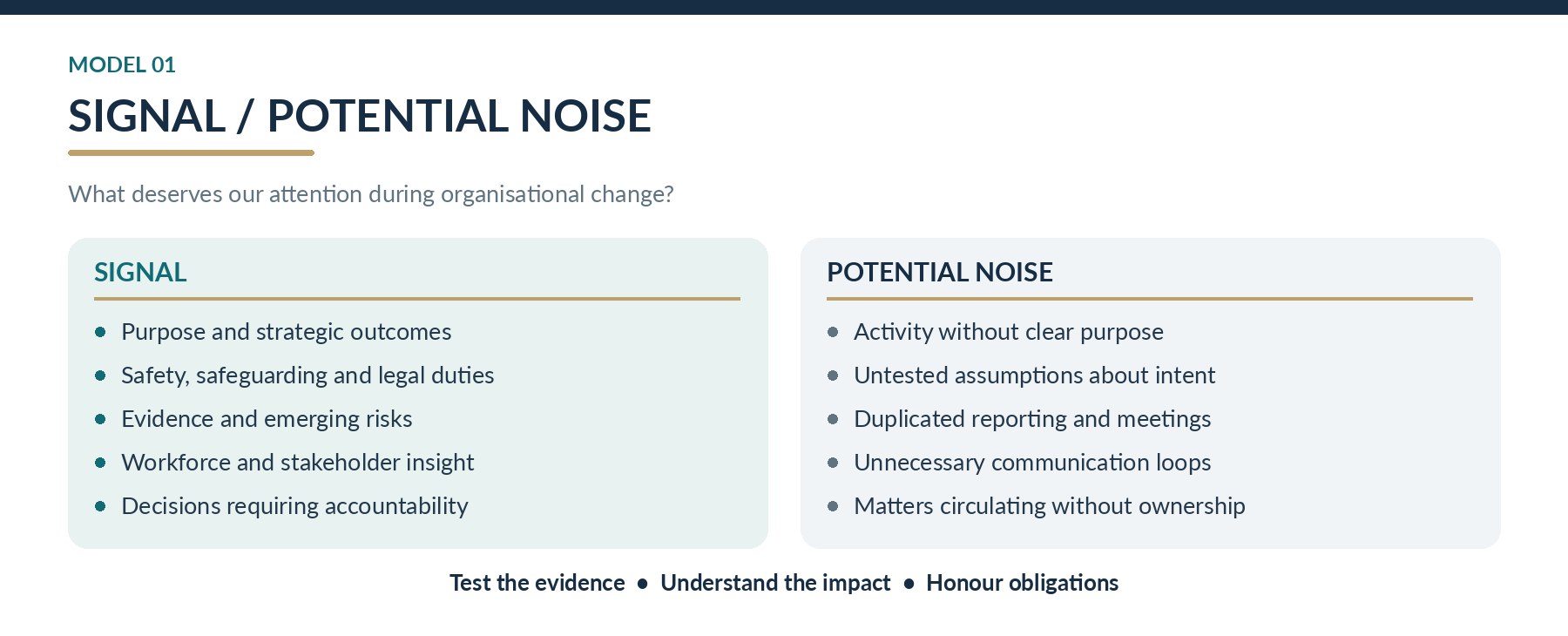
Model 1. Signal-to-noise as a change leadership discipline. © Tarran Deane.
When organisational change moves faster than relationships can adjust
Rapid change places pressure on even capable leaders. Resources are constrained, expectations are high and decisions that have been deferred can no longer wait. When initiatives overlap, this pressure compounds, as explored in Leading Through Change Fatigue.
A school may need to reconsider a program. A community organisation may have to reshape services. An enterprise may introduce technology that changes familiar work overnight.
The decision can be necessary, properly authorised and supported by evidence. It can also disappoint people who have contributed years of commitment to what came before.
A decision does not have to be popular to be made with care. And disagreement does not have to diminish trust.
The leader’s responsibility is to consult appropriately, decide within authority, explain what can be explained and acknowledge consequences without promising everyone their preferred outcome. Executive direct reports contribute evidence, challenge assumptions and help people understand what the decision means in practice.
Nor should a decision be treated as beyond scrutiny simply because it has been announced. Material new evidence, safety concerns and legal obligations still require attention.
The strength of an executive team is demonstrated not by universal agreement but by its ability to debate respectfully, decide responsibly and act together.
Trust makes difficult work possible
Stephen M. R. Covey’s The Speed of Trust provides a useful perspective:
“When trust goes down, speed goes down and cost goes up.”
Stephen M. R. Covey
When trust is established, executive colleagues can ask challenging questions without assuming hostility. Leaders can communicate briefly without every pause becoming a mystery. People can accept that a decision is difficult while trusting that it was taken seriously.
Low trust creates its own workload: duplicate meetings, defensive explanations, uncertainty and the conversation after the conversation. Legitimate scrutiny is never noise; avoidable speculation often is.
This is why trust and focus belong together. Protecting attention while neglecting relationships can become a false economy.
Change sponsorship: don’t abdicate your presence to someone else in the story
As the sponsor of significant change, you bring something nobody else can fully substitute: accountability for why the change matters.
Prosci’s change management research distinguishes two preferred senders. Employees look to senior leaders for organisational reasons for change, and to their immediate supervisors or people managers for messages about personal impacts. Its research also consistently identifies active and visible sponsorship as a leading contributor to successful change.
Your change advisor can prepare the strategy. Communications colleagues can craft the materials. Executive directors and supervisors can explain the practical consequences. But the head honcho still needs to turn up.
Don’t abdicate your presence to someone else in the story.
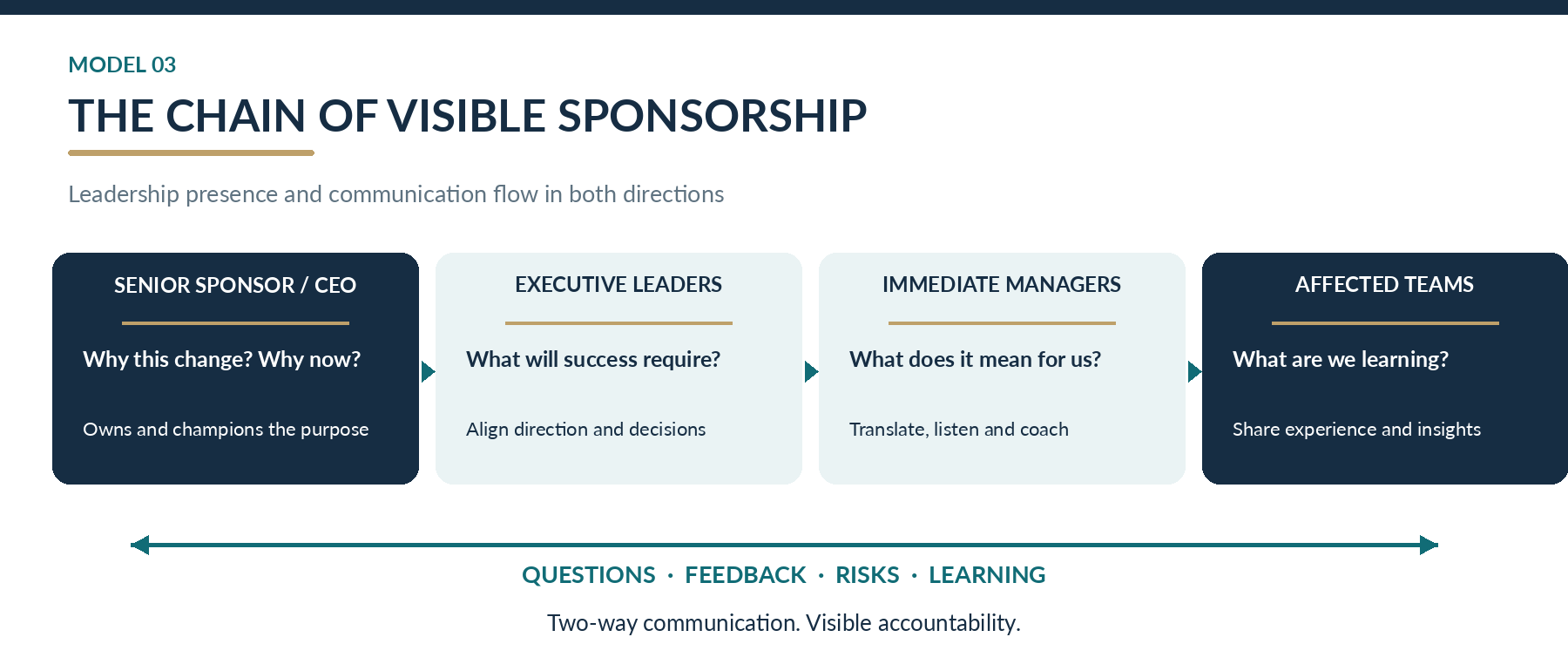 Model 3. Visible change sponsorship and two-way feedback, informed by Prosci. © Tarran Deane.
Be ready with three to five important points. Name the elephant in the room. Answer what you can. A little self-deprecating humour may help. Finish with a clear next step.
You do not need to perform enthusiasm. You need to be believable and involved.
Turn up at a worksite, join a team conversation, explain a difficult choice or listen to a question without rushing to defend yourself. Frontline experience may reveal something a Board paper or implementation report has missed.
Your presence is an opportunity to hear the signal, not just deliver the message.
And while we’re at it, tell your face you’re happy!
This one’s for everyone listening, not just the person speaking.
Someone is presenting an idea they’ve worked hard on. Across the table sits a thoughtful colleague: arms folded, brow furrowed, expression unreadable. They may be deeply interested. Their face, however, looks as though someone’s just handed them the electricity bill.
Here’s my occasional Australian encouragement: “Tell your face you’re happy!” Or at least interested.
Lean forward a little if that’s comfortable. Look up from the laptop. Offer a nod, an encouraging word or a genuine smile. Put some warmth into the questions.
Compare “Why would you do it that way?” with “Talk me through what led you to that approach.”
Both can test the thinking. Only one readily invites a conversation, the other could feel quite discouraging.
| May feel discouraging | Creates connection |
| Focus stays on the laptop | Pause other work and show you are listening |
| Silence without context | “That’s useful. Give me a moment to consider it.” |
| “Why would you do it that way?” | “Talk me through what led you there.” |
| Questions that sound like a verdict | Questions that invite further thinking |
| No indication of next steps | “Here’s what I’d like us to do next.” |
Table 1. Attentive listening and constructive questioning. © Tarran Deane.
Be curious before you become critical. You can challenge an idea without diminishing the person who brought it.
And never fake it. If you’re concerned, say so respectfully. If you need time, say that too. Attentiveness does not require constant smiling or eye contact; people communicate differently across cultures and neurotypes.
The objective is not a permanent grin. It is making genuine interest, respect and thoughtful scrutiny visible enough for others to contribute with confidence.
The quiet observer has a strength worth protecting
Some executives listen far more than they speak. They absorb detail, consider alternatives and keep their counsel while forming an opinion. That can be a tremendous asset during complex decisions.
But a direct report may leave the meeting wondering: Did she agree? Am I heading in the right direction? Was that silence concern or simply reflection?
The quiet observer does not owe anyone a running commentary. She can, however, offer a few reassuring words: “That’s useful; I’d like to reflect on it,” or “I’m comfortable with this direction. Please proceed.”
Her reports share the responsibility. Rather than guessing, they can ask: “What would you like me to do next?” or “Is there anything you’d like approached differently?”
We should not require leaders to reveal every thought. We can reasonably expect sufficient clarity for others to succeed.
Different strengths, a more capable team
I use strengths and working-preference tools to help leaders explore these differences without attaching permanent labels.
As an accredited Team Management Profile assessor, I use its work-preference framework to help teams understand how their contributions fit together. Gallup CliftonStrengths provides language for natural talent themes across executing, influencing, relationship building and strategic thinking. Crystal Knows can offer quick, preliminary DISC-style communication predictions based on LinkedIn information.
They are different kinds of tools, with different limits. An inferred profile is not a diagnosis, a hiring assessment or permission to assume someone’s motives. The person themselves remains the most important source of insight.
Consider an illustrative executive team. The relational connector notices uncertainty among staff. The focused decision-maker keeps the strategic priority in view. The discerning observer spots an assumption nobody has tested.
Together, they can improve both the decision and its implementation, provided they agree how to work: circulate recommendations before meetings, invite informed challenge, state what is decided and confirm who owns the next action.
Nobody has to become somebody else. Connection, execution and reflection become shared strengths.
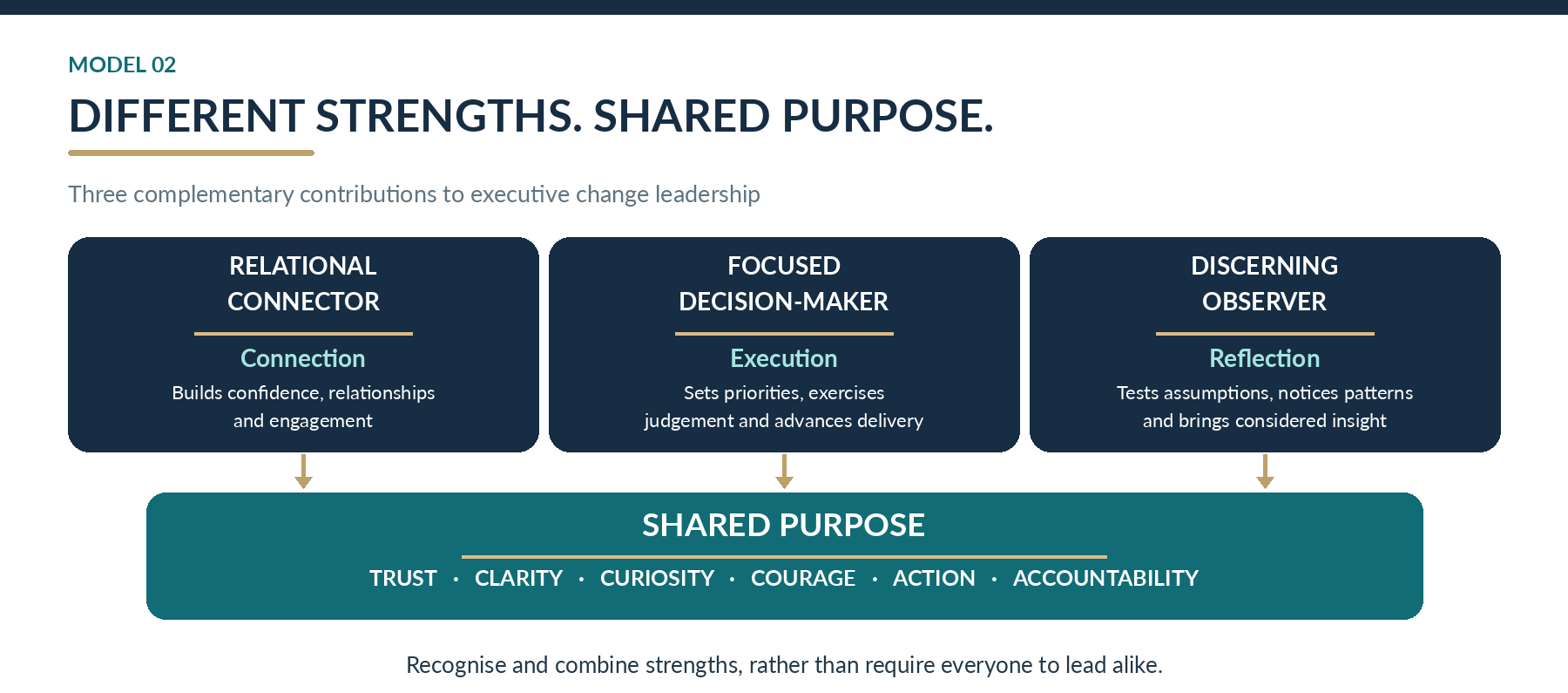
Model 2. Three complementary leadership contributions. © Tarran Deane.
Mutual responsibility, not a personality contest
The leader creates the conditions for others to succeed: clear direction, appropriate consultation, timely decisions, accessible escalation and meaningful feedback. Their executive reports owe sound advice, respectful challenge, professional discretion and accountable implementation.
A leader who holds confidential responsibilities may not be able to explain everything. Their reports can respect that. Equally, confidentiality should not become an excuse for unclear delegated authority or unanswered critical issues.
Executive reports should not be left carrying the whole story of a decision made above them. That’s hardly a fair go. Equip them to explain the direction and invite them to bring back what employees are experiencing.
When a lawful and appropriate decision is final, supporting implementation is part of executive responsibility. So is continuing to raise fresh evidence, safeguarding concerns and material risks.
The companion Leading Well Together infographic turns these expectations into six practical commitments for each side and three questions for the team to discuss.
Australian values, obligations and good governance
Our workplaces include informal teams, reserved leaders, many cultures and differing expectations about authority. There is no single Australian way to show care.
But values must be visible in action. Compassion can mean listening warmly or making a difficult decision that protects services. Integrity can mean speaking openly or maintaining legitimate confidentiality. Courage can mean challenging an assumption and remaining willing to hear the response.
Importantly, Australian obligations don’t disappear in the rush to deliver. Fair Work guidance identifies consultation duties under applicable awards, agreements and legislation. Safe Work Australia recognises poorly managed organisational change as a potential psychosocial hazard. Registered charities within scope of ACNC Governance Standard 5 must take reasonable steps to ensure their Responsible People act with care, diligence and integrity.
A Board’s task is not to prefer the friendliest personality. It is to seek assurance that decisions, safeguarding, consultation, capacity and accountability support the organisation’s purpose.
Try this in your next executive conversation
Before your next major change decision, give the team ten minutes for three questions: What matters most right now? What strengths are we bringing to the decision? What are we assuming rather than knowing?
Then agree who decides, who communicates the organisational reasons, who speaks with affected teams and how questions will return to the decision-maker. Identify the moments when the sponsor must personally show up. Confirm what is genuinely confidential and what can be communicated clearly.
It is a small investment of time. Done consistently, it can reduce avoidable uncertainty while protecting the attention needed for difficult work. The companion infographic provides a useful starting point.
Different strengths. Shared purpose.
A reserved leader can be deeply caring. A relational executive can be strategically disciplined. The quiet observer can be the person who asks the question that changes everything.
And each can learn something from the others.
The invitation is to protect the strengths people bring while making the small adjustments that enable colleagues to trust, understand and act together.
Clarity helps us identify the signal. Courage helps us confront it. Integrity determines what we do next.
Trust allows us to bring our different strengths to the same purpose.
If your executive team is navigating demanding change, perhaps the most useful next conversation is not “Who’s doing this wrong?” but “What would help us lead well together?”
That is a practical place to begin. Through executive coaching and organisational change management consulting, I work with leaders and teams to strengthen change sponsorship, strategic leadership, stakeholder engagement and readiness while connecting purpose, strengths and accountable execution.
About Tarran Deane
Tarran Deane is an Australian executive transformation and change advisor, executive coach, published author, speaker and Board director. Based on the Gold Coast, Queensland, she supports clients across Brisbane and Australia. Her work spans government, community services, education, mining and enterprise transformation. She is an accredited Team Management Profile assessor, a certified Prosci change management practitioner and a graduate of Strategic Leadership. She serves voluntarily on the Board of Calrossy Anglican School, an independent school in New South Wales. tarrandeane.com.
References and further reading
- The Diary of a CEO: Kevin O’Leary interview and transcript.
- Steve Jobs: WWDC Closing Chat, 1997.
- FranklinCovey Australia: Building a Winning Culture, Inspire Trust.
- Prosci: Communications Checklist for Change Management; Primary Sponsor’s Role and Importance.
- Team Management Systems: Team Management Profile.
- Gallup: The 34 CliftonStrengths Themes.
- Crystal Knows: DISC Prediction.
- Fair Work Ombudsman: Consultation and Cooperation.
- Safe Work Australia: Poor Organisational Change Management.
- ACNC: Governance Standard 5, Duties of Responsible People.
Editorial note: The Leadership Shock Factor and companion commitments are an applied reflection framework, not a validated psychological instrument or formal compliance standard. The team example is illustrative.
COMPANION EXECUTIVE REFLECTION RESOURCE